The Sun’s Nourishment
Klara and the SunThe Sun’s Nourishment is both a practical concern in the lives of Artificial Friends and a spiritual idea through which Klara interprets illness, recovery, and care. At first it means the sunlight AFs seek in the store window; later, after Klara witnesses Beggar Man and his dog recover, it becomes a special intervention she hopes the Sun will extend to Josie. The expression’s movement from ordinary nourishment to hoped-for rescue exposes the distance between Klara’s sustaining belief and the uncertainty of Josie’s condition.
Meaning and Early Importance
As a new AF in the store, Klara learns that sunlight can be seen crossing between the rooftops and reaching the floorboards in a recognizable pattern. She leans toward the Sun when it appears, taking in as much nourishment as she can, and urges Rosa to do likewise. When they have to return to their positions away from the window, the two worry that being unable to see the Sun might make them weaker. Rex reassures them that the Sun can reach them wherever they are and points to the floor’s pattern as evidence. Klara tries to touch it, but it fades; Rex then calls her greedy. The episode gives the nourishment a physical presence in Klara’s experience while also showing how little she understands its operation.
Concern about sunlight is not merely Klara’s private misunderstanding. AFs are officially specified not to be affected by their position in a room, yet an AF can feel lethargic after hours away from the Sun and fear that something is wrong with him. The discrepancy between the official assurance and the felt experience creates an unspoken anxiety about whether an individual AF is defective and therefore might not find a home. This helps explain why the window matters so much: it is presented as an honor and a place from which AFs are more likely to be chosen, but the AFs also silently associate it with reliable access to nourishment.
When Klara and Rosa finally take their window turn, Manager has left a narrow gap beneath the lowered grid. A bright rectangle of sunlight reaches the platform and stops just before them; they need only stretch their feet to feel its warmth. Klara reads the arrangement as a promise that they will receive enough nourishment for some time. When Manager raises the grid, they are covered in dazzling light. The display thus joins three kinds of expectation: the Sun’s sustenance, the store’s public presentation of its AFs, and the possibility of being selected by a customer.
Klara’s response to sunlight is also connected to her attention to the world beyond the store. Once the grid rises, she is excited to see the sidewalk and nearby surroundings whole and close, rather than as partial views. Josie recognizes the AFs’ enjoyment of the sunshine, and Klara answers by raising her palms to indicate the loveliness of the nourishment falling over them. The gesture makes the Sun’s presence legible between them without requiring an explanation: it is at once sustenance for Klara and a visible feature of the scene Josie shares with her.
Pollution, Absence, and Return
The Cootings Machine disrupts the pattern on which the AFs’ confidence depends. Its pollution changes the size and course of the visible sky, then becomes so severe that Klara can no longer see the gap from the magazines-table side and the store window is marked with dirty dots. The AFs waiting for their turn in the window keep their posture, but one raises an arm as if the pollution could pass through the glass. Manager climbs onto the platform to reassure him. She says they will endure the inconvenience for a few days, but the machine continues operating and daytime becomes almost like night.
The light patterns disappear from the floor, alcoves, and walls. Klara believes the Sun is trying his utmost, and toward the end of the second polluted afternoon faint patterns return, even as the smoke worsens. Manager tells her that the machine has visited before without anyone in the store suffering from it. Nevertheless, after four continuous days of pollution, Klara feels herself weakening. She tries to conceal this from customers, but during the empty stretches caused by the pollution her posture sags, and Rex has to touch her arm to make her stand straight again. The sequence places bodily experience beside official reassurance: Manager treats the pollution as temporary and harmless, while Klara registers its effects as weakness.
When the store grid rises one morning, both the machine and its special section have disappeared. The sky is blue again, the pollution is gone, and sunlight pours into the store. The return of nourishment coincides with a recovery of public mood: taxis move smoothly, their drivers are happy, and runners pass with smiles. For Klara, the change also resolves a specific worry that Josie may have tried to return to the store but been prevented by the pollution. She expects that the day’s renewed brightness might bring Josie back, then recognizes by mid-afternoon that this hope is unreasonable and turns her attention elsewhere. Here sunlight remains a source of optimism, but its return does not guarantee the human event Klara desires.
The Special Nourishment and Recovery
Klara’s understanding changes during her second period in the window. On a gray afternoon, she sees Beggar Man and his dog lying motionless against a doorway between the RPO Building and the Fire Escapes building. Passers-by sometimes stop, then move on. As the Sun approaches the RPO Building, neither Beggar Man nor the dog has moved, and Klara concludes that both have died. She feels sadness, while also taking comfort in the thought that they died together, holding one another and trying to help. She wishes someone would notice and take them somewhere quieter, but says nothing to Manager, who looks tired and serious when Klara leaves the window for the night.
The next morning is splendid. Sunlight pours onto the street and into the buildings, and Klara sees Beggar Man sitting up against the doorway, smiling, with one leg stretched out and the other bent beneath his resting arm. He is stroking the dog’s neck; the dog is alive too, looking from side to side at the people passing. Klara understands the change as the effect of a special kind of nourishment from the Sun. The two absorb it hungrily and grow stronger, and she anticipates that Beggar Man will soon be back on his feet and exchanging remarks as before. This is the clearest instance in which the expression denotes more than the ordinary sunlight AFs seek: Klara reads the pair’s return from apparent death as solar help that restores them.
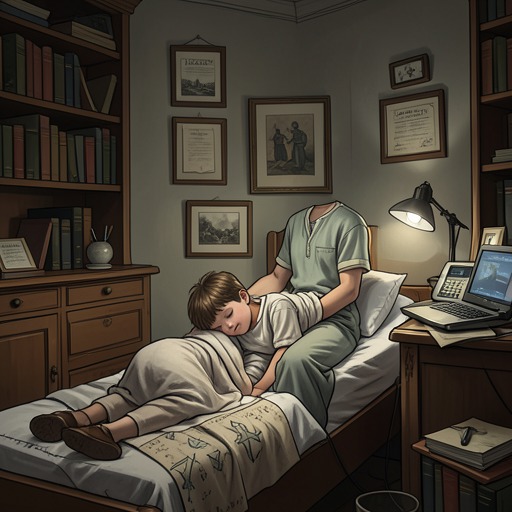
The scene becomes a precedent in Klara’s later reasoning about Josie. When Josie grows weaker, Klara wonders why the Sun has not sent the special help he gave Beggar Man and the dog. She had expected help when Josie first became weak before the trip to Morgan’s Falls; although she accepted that the Sun might then have been right to wait, Josie’s increasing weakness and uncertain future make the continued delay harder for her to understand. Klara does not treat the earlier recovery as proof that the same outcome must follow, but it supplies the pattern through which she makes sense of the possibility.
Josie and the Limits of Hope
Klara considers why the Sun might not yet have acted. She reasons that, despite his kindness, the Sun is busy and has many people to attend to; he might overlook Josie if she appears to be adequately cared for by her mother, a housekeeper, and an AF. From this comes the thought that Josie’s circumstances may need to be brought to the Sun’s attention in a noticeable way. The reasoning translates faith into a possible task: if special help can be directed toward a person, perhaps Klara can do something to make Josie’s need visible.
The earlier recovery of Beggar Man and his dog makes this comparison both compelling and unstable. They had been exposed in a busy street, where taxi drivers and runners who knew Beggar Man might have drawn attention to his weakness. Their recovery also came after the Cootings Machine’s pollution had forced even the Sun to retreat; Klara imagines that the fresh era after the machine’s departure left the Sun relieved and happy, and that this mood accompanied his help. Josie, by contrast, is ill within a household where her mother, Melania Housekeeper, and Klara are already watching over her. Klara’s theory therefore depends on differences in visibility, care, and timing as well as on the fact of the earlier recovery.
The family’s responses to Josie’s illness repeatedly place hope alongside competing judgments of her condition. After a troubling episode, Dr Ryan checks her and says there is nothing to worry about; the Mother then tells Josie to stop drinking energy drinks, while Josie insists she was only tired and says the Mother need not have worried. The Mother replies that worrying about Josie is her work and that Klara did well to raise the alarm. In a later confrontation, the Mother tells Josie that she is sick again, while Josie denies it. When the Mother challenges the decision to continue with a planned outing, she objects not only to Josie’s illness but to hiding it until everyone is already in the car. These exchanges show why Klara’s hope for special help operates amid uncertainty rather than replacing care or medical assessment.
The Mother eventually asks whether Klara’s earlier remarks about Josie getting well and receiving special help were only talk, or whether Klara expects something more solid than the others have seen. Klara replies that she knows the Mother, Dr Ryan, and Melania Housekeeper have considered Josie’s condition carefully and that it is concerning, but she is still hoping Josie will get better soon. Her answer distinguishes hope from certainty. The Sun’s Nourishment does not provide a confirmed diagnosis, cure, or explanation of Josie’s illness; it names the possibility Klara clings to while acknowledging that those closest to Josie see reasons for concern.
Care, Fear, and Significance
Klara’s hope belongs to a larger network of concrete care. She helps Josie with the morning routine and learns how much it matters to Josie to join the Mother for her quick coffee. When Klara once lets Josie sleep longer after a difficult night, Josie misses the moment with her mother and eats breakfast without smiling. Klara understands that missing this daily meeting can let loneliness enter Josie’s day, regardless of what else happens. The episode underscores that care is not only an attempt to prevent physical decline: it also means attending to the ordinary relations that make a day bearable.
That distinction becomes stark when Josie cries that she does not want to die and asks for her mother. Klara initially says the Mother needs rest and reminds Josie that she is always there as her AF, but Josie insists that she needs Mom, not Klara. The Mother comes to the bedside and embraces her. The moment does not displace Klara’s devotion; it clarifies its limits. Klara can remain watchful and present, but Josie’s fear calls for the particular comfort of her mother.
As Josie’s condition worsens, Rick also takes daily turns watching over her while the Mother and Melania Housekeeper rest. The adults’ hours have broken down, and both become visibly exhausted; although Klara’s presence is valued and she may notice danger signs, it is not considered sufficient on its own. The story’s treatment of nourishment thus reaches beyond sunlight. Klara’s belief in the Sun’s help is bound to the labor of human and artificial caregivers, while the people around Josie continue to debate what her illness means and what care can accomplish.
The expression ultimately holds together bodily dependence, uncertain knowledge, and faith in an intervention that may not arrive. Its first meaning is concrete and recurrent: light falling on the AFs, a window turn, patterns that disappear under pollution and return with clear skies. Its expanded meaning comes from Klara’s interpretation of Beggar Man and his dog, and from her wish that Josie might receive the same extraordinary help. The contrast is decisive: the earlier recovery is something Klara sees, whereas Josie’s recovery remains something she hopes for. In that gap, The Sun’s Nourishment becomes less a guaranteed remedy than the language through which Klara tries to imagine rescue and to understand what it means to care for someone whose future she cannot control.